Revenue operations for high ticket businesses

There is money in your business you have already paid for and never collected.

Not more leads. Not another agency. I find where the money is escaping between the first click and the last renewal, and I put a number on it before you buy another lead.

Book the 20 minute diagnostic
Free, no pitch. You leave with a rough figure on which stages are open in your business, whether or not you ever pay me anything. I take six at a time, because I run every audit myself.
01Awareness
02Lead
03Conversion
04Fulfillment
05Upsell
06Continuity
Six places money escapes on the way from a stranger to a renewal. Three are lit because on floors this size those are the three I find open most often. Most owners can only see one of them.

Check the ones that are true this week

Your cost per booked call went up again this quarter and nothing about your funnel changed. Same conversation, higher price.
Show rate slipped under seventy and nobody can tell you exactly which week it started.
Two closers carry the number. The rest sit near half quota, and you know which is which by Wednesday.
There are leads in GHL from March with two attempts on them. Not because anyone is lazy. Because the phone rang with something newer, and it rings every day. The ones that do close usually answer somewhere around the sixth attempt, and almost nobody on a live floor gets to the sixth.
A proposal went out three weeks ago, got a yes on the call, and never got billed.
Someone bought from you last year, loved it, told people, and has not been offered a second thing since.
You bought a tool that was supposed to handle all this. It sent something that did not sound like you, so you turned it off.
And when you talk about next month, you still say hopefully.

None of that is a people problem. It is a queue, and a queue can be counted. Twenty minutes is enough to tell you which one of those is costing you the most.

Spending more every quarter to stand still

The reflex, when the number is short, is to go back to the top of the funnel and buy more awareness. It is the lever everyone knows how to pull, and it is the one that got more expensive.

Meanwhile the expensive part has already happened. The lead was paid for. The call was booked. The proposal went out. Somebody said yes and never got billed. Somebody bought once and nobody ever sold to them again. You have already paid for all of it. It moves at whatever speed is left over after today's calls.

Nothing in there is lost. It's queued behind today's calls.

And a queue is a resourcing problem, not a character problem. Nobody on your floor is doing anything wrong. They're pointed at the next lead, which is exactly what you hired them to do.

The leak is rarely where you think it is

Most owners assume the problem is sales. Sometimes it is. Just as often it is a broken handoff, a delivery bottleneck quietly costing you referrals, a payment plan nobody chases, or a second offer that was never built. It is not marketing, it is not sales, it is not fulfillment. It runs underneath all three.

You will usually feel it in one of them. It is almost never only one.

Twenty closers, one system, their best number on that list

An eight figure company brought me in to train their entire closing floor, with the CEO in the room. Then I pointed the system at the conversations nobody had time to work. Four thousand of them, sitting in the CRM behind that day's calls.

Their floor had been getting about five percent out of that list. The system came back at forty percent, the highest that company had ever recorded on it.

Sixteen hundred people answered. Twenty closers can work a fraction of that in a day, so they worked what they could reach: 160 booked calls, 50 closes, average deal around twenty thousand, about a million dollars in cash. The rest of those replies are still sitting there, which is the whole point.

They closed just under a third of the calls, higher than they close cold traffic, because these were people who had already talked to them once.

No new leads. No new ad spend. That is one stage of six, worked once, on a floor that was already good at selling.

The company is not named here, on purpose. The result is theirs as much as mine.

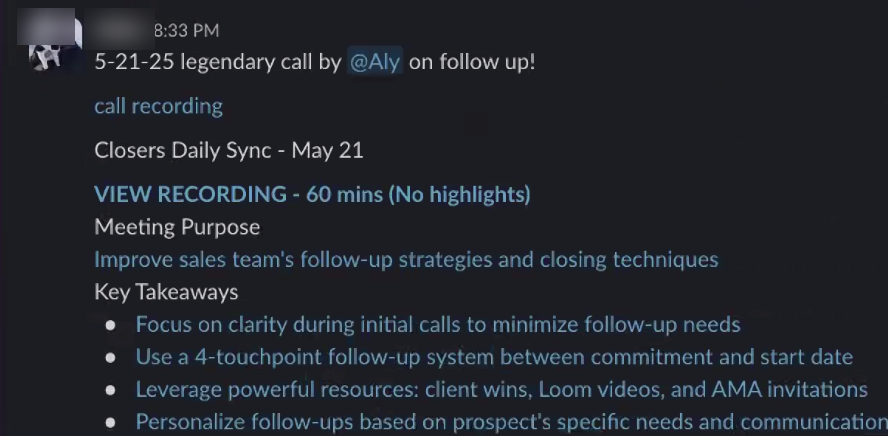
Message from the chief executive after the closing floor ran the system
The chief executive, in their own internal channel, during the run.

What it looks like on somebody else's floor

Same discipline the audit installs, run by closers inside offers that were already selling. Screenshots as they came in, then the men on camera.

Message from Rafay reporting thirty thousand dollars closed in one week
Rafay
Conversion stage. $30K recovered in one week from conversations already in the pipeline, 10 of the 11 with no new spend behind them. Another $17K over the three weeks after.
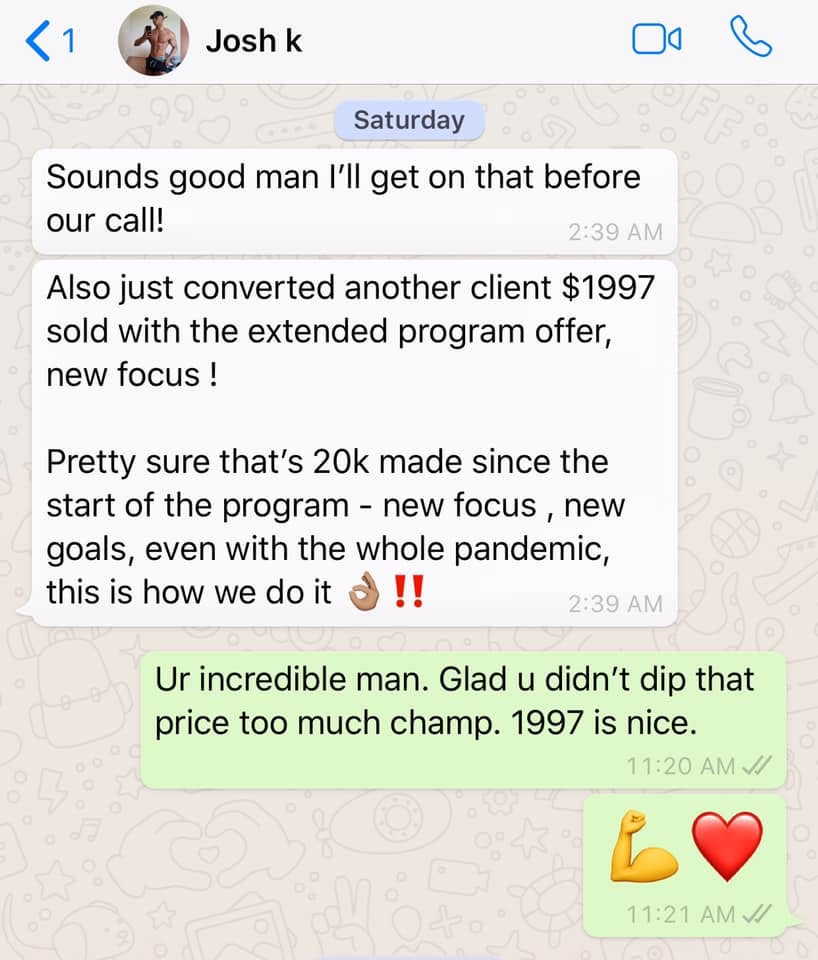
Message from Josh reporting money collected inside 72 hours
Josh
Conversion stage. $8,339 recovered inside 72 hours, 4 of 5 calls closed, roughly $20K in the stretch that followed. Nothing new was spent to get any of it.

In their own words, unscripted

Rafay
On the $30K week, and the $17K after it
Josh
On the $8,339 inside 72 hours
Step one costs nothing. Twenty minutes, a specific set of questions, and a straight answer on whether there is money worth going after.
Book the 20 minute diagnostic

The record, in numbers

$50K to $800K
Monthly revenue as COO of Scaling Group, Beverly Hills, at margins above 70%.
3 to 300+
High ticket clients in under eleven months, average client investment above $30,000.
$2.37M
Collected personally over two and a half years.
5% to 40%
Reply rate on four thousand conversations already sitting in one company's CRM. Their record on that list.
About $1M
Cash from those replies, worked by twenty of their closers. No new leads, no new ad spend.
Highest
Cash collected per scheduled call on every floor I have worked. Revenue divided by opportunity, which is the only number that measures what comes out of a pipeline you were handed.

Every number on this page is mine or was recorded on a floor I ran. Nothing here is an average, an industry benchmark or a projection. I carried a bag on the floors I later ran, which is why I am willing to be this specific about them.

What I actually am

Most people you can hire will find the leak or seal it. I do both, and I stay while it's being done.

What usually gets hired

A consultant who diagnoses and leaves you a deck. An agency that sends more traffic into the same leaks. A closer you rent by the hour who only touches one stage of the six.

What I do instead

I have owned operations, follow-up, fulfillment and sales in the same building at the same time. I find the money, then I stay and help you collect it.

The reason I can see six stages is that I have stood at three different heights in the same business.

On the phone. I was the closer with the highest cash collected per scheduled call on every floor I have worked. That never came from being the best talker in the room. It came from working the conversations everybody else had already moved past.

Over a floor. I trained twenty closers with the CEO sitting in the room, then pointed the system at four thousand conversations already sitting in their CRM. It came back with that company's record on the list and about a million dollars in cash, with no new leads and no new ad spend.

Over a company. Two years as COO of Scaling Group in Beverly Hills, from fifty thousand a month to more than eight hundred thousand, at margins above seventy percent. Acquisition, sales and fulfillment in the same building at the same time, which is why I can tell a sales problem from a handoff problem, and why I know a bottleneck in delivery costs you referrals you will never see leave.

That growth did not come from more leads. It came from closing and keeping the people who were already there.

Aly Samaha
Aly Samaha on the front cover of Ultimate Achievers Magazine, issue 100
Seen and heard
  • Ultimate Achievers Magazine, front cover and feature, issue 100. ultimateachieversmagazine.com
  • Success Profiles Radio, a top 100 business podcast.

How it works

Three steps, in order, and you can stop after any one of them.

1
Free

The diagnostic call

Twenty minutes. I ask a specific set of questions about your numbers, your pipeline and your delivery. At the end I tell you straight whether there is money worth going after, and roughly where I would expect it to be. If there is not, I say so and we are done.

2
Paid, and it credits back

The deep audit

I go through the whole chain as one piece rather than department by department. You get five documents and one number.

If you decide to implement it yourself, you keep the map and owe me nothing further. If you decide to do it with me, the entire audit fee credits against the work. Either way you are not buying a report.
3
Scoped from the audit

Implementation

I seal the leaks the audit found, biggest first, working alongside whoever owns that part of your business. Scope and price come out of what is actually there, so neither of us is guessing on a first call. Ongoing operating support afterwards is available and entirely optional.

Nothing is priced before the call. Quoting an audit before I know what is in your building would be guessing, and you would be paying for the guess.

Step one costs nothing. Twenty minutes, a specific set of questions, and a straight answer on whether there is money worth going after.
Book the 20 minute diagnostic

Why this is not the tool you turned off

You have probably already bought software that promised to work your old conversations. It sent something that did not sound like you, so you turned it off. That instinct was correct.

I read every message before it goes

Not a template with a first name dropped in. I read the actual thread, work out what happened, and write the next message for that person. At my volume that is possible. At agency volume it is not, which is why nobody else does it.

It sends from your closer, in your closer's voice

Nothing goes out under my name or from a tool. The person who had the conversation sends the message, so the buyer sees the same human they were already talking to.

The leak gets sealed, not just found

A consultant hands you a deck and leaves. Every fix the audit recommends is written out as the actual sequence, script or process, handed to whoever owns that part of your business, and built to run once I am gone.

This is the difference between a report about your revenue and someone standing in the room while it gets collected.

What the audit puts in your hands

Five documents. Written for an operator, not a boardroom.

Document one

The Leak Map

Every place revenue is escaping across all six stages, marked and sized. One page you can put on a wall.

Document two

The Uncollected Cash Report

Money you have already earned and not received. Stalled deals, unsigned proposals, broken payment plans, buyers never sold to twice. Named, counted and totalled.

Document three

The Conversion Autopsy

Where your journey actually dies, stage by stage, with the real drop off at each step measured against what it should be.

Document four

The Owner Dependency Score

What still cannot happen without you, what that is costing in throughput, and which pieces come off your desk first.

Document five

The Recovery Sequence

What to fix, in what order, with the expected recovery beside each item. Built so it can be handed to your team and run without me.

And the number

What it adds up to

One figure for what is recoverable, with every assumption shown so you can argue with them. If the number does not justify the next step, do not take the next step.

Who this is for

A good fit

  • High ticket offers, roughly $5,000 and above
  • Revenue already happening, not a pre launch idea
  • A list, a pipeline or a customer base with history in it
  • An owner who can approve a change without taking it to a committee
  • Coaching, consulting, education, agency, professional services, done for you

Not a fit

  • Pre revenue, or no data to look at yet
  • Low ticket volume businesses where the real fix is media buying
  • Owners who want a report and will not act on it
  • Anyone looking for a closer to rent by the hour
Want to know what that looks like in your business? Twenty minutes, free, no pitch. You leave with a rough figure on which stages are open, whether or not you ever pay me anything.
Book the 20 minute diagnostic

The questions everyone asks

What does it cost?

The diagnostic call is free and it is genuinely free. The audit is a flat fee I will give you on that call, once I know roughly what I am walking into, and it credits in full against implementation if you decide to go further. Implementation is scoped from what the audit actually finds, so anyone quoting you that number before looking is guessing.

What do I actually walk away with from the free call?

A rough figure. Which of the six stages look open in your business, roughly what is sitting in them, and which one I would go at first. It is a guess off twenty minutes and I will say so out loud, and it is still more than most owners have ever had put on this. You keep it whether or not you ever pay me anything.

What if you look and there is nothing there?

Then I tell you on the call, before you have spent anything. That happens, and it is a useful answer. Usually it means your problem is genuinely upstream and you need traffic, not recovery, in which case I will say so and point you at the right kind of help.

How much of my time does this take?

Twenty minutes for the call. For the audit, a session with you and short conversations with whoever runs sales and delivery. I work from your numbers and your systems, not from your calendar.

Is this just follow up?

No. Follow up is one stage of six and it is where I started, not where I stopped. The audit looks at awareness, lead, conversion, fulfillment, upsell and continuity, because the biggest leak is usually not the one you would have guessed.

Will you sell to my list or talk to my clients?

Not without your say so, and never as anyone other than me. Implementation is built to be handed to your team and run without me, which is the point.

Who actually does the work?

I do. There is no team behind me and no junior analyst writing your report. That is why I take six at a time. That is the constraint that keeps the number of businesses I can look at small, and it is also the reason the audit is worth reading.

Find out if there's money.

Twenty minutes. No pitch. I ask a specific set of questions and tell you honestly whether there is anything worth going after in your business, and you leave with a rough figure on it either way.

If there isn't, that is a useful answer and it costs you nothing.

Whatever is escaping does it again next month, at the same rate, whether or not anyone has sized it.

I take six at a time, because I run every audit myself.

Book the diagnostic call